
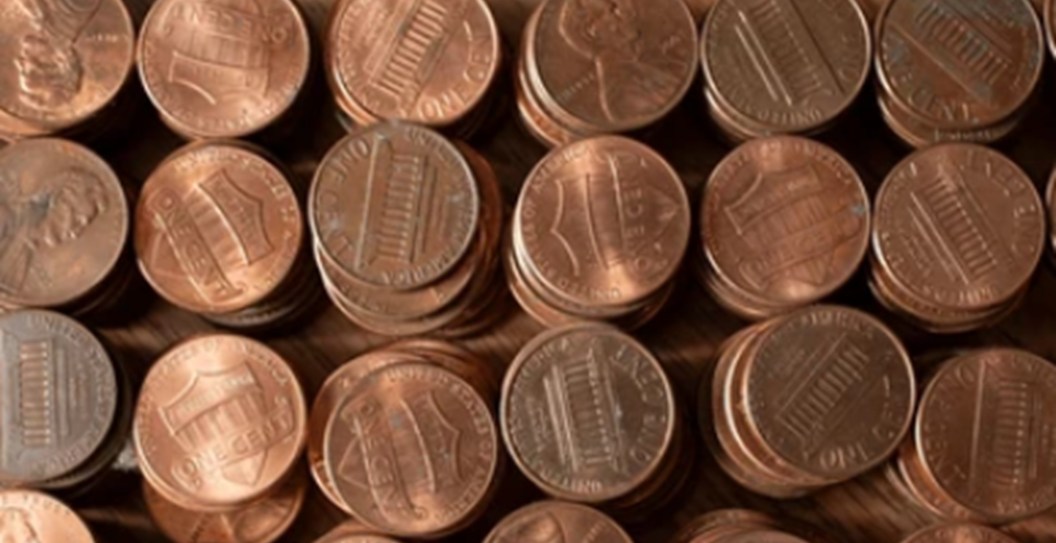
President Donald Trump is pulling the plug on the penny.
Videos by Wide Open Country
The U.S. Mint has placed its final order for penny blanks and will stop producing the coin once that supply runs out, the Treasury Department confirmed. The decision comes amid skyrocketing production costs and declining usage, ending the run of a coin that has been in circulation for over 230 years.
The move is expected to save the federal government approximately $56 million per year, according to a Treasury official, via the Associated Press. That savings comes primarily from lower material and manufacturing costs, which have jumped by more than 20% in 2024 alone.
President Trump first announced his decision in February, writing on Truth Social:
"For far too long the United States has minted pennies which literally cost us more than 2 cents. This is so wasteful! I have instructed my Secretary of the US Treasury to stop producing new pennies."
The one-cent coin has long operated at a loss due to what economists call "negative seigniorage." In other words, it costs more to make the coin than it's worth. The Mint has tried for years to find cheaper metals, but costs kept rising.
A Penny Not Saved
Currently, there are about 114 billion pennies still in circulation. That's $1.14 billion worth. But most rarely change hands. Many end up in drawers, jars, or lost in couch cushions. Despite their diminished role in commerce, pennies made up more than half of all coins struck by the U.S. Mint last year, with 3.2 billion minted in 2024 alone.
Once the coin disappears from circulation, retailers will likely follow Canada's model and begin rounding prices to the nearest five cents (up or down) to compensate.
Congress Weighs In
Trump's move is already gaining momentum in Congress, with bipartisan support for codifying the change.
On May 1, Sens. Mike Lee (R-Utah) and Jeff Merkley (D-Ore.) introduced the Make Sense Not Cents Act. The day before, Reps. Lisa McClain (R-Mich.) and Robert Garcia (D-Calif.), along with Sens. Cynthia Lummis (R-Wyo.) and Kirsten Gillibrand (D-N.Y.), unveiled the Common Cents Act.
Both bills aim to formally end penny production while laying out policies for rounding transactions.
From Copper to History
First minted in 1793, the penny is one of America's oldest coins. It's undergone numerous changes, from solid copper to today's zinc-copper composite. Abraham Lincoln's profile was added in 1909, commemorating his 100th birthday, making it the first U.S. coin to feature a real person.
Though officially called the "cent" or "one cent piece" by government agencies, it's been known colloquially as a "penny," a nod to British coinage.
Penny production will continue until the Mint runs through its final supply of blanks, likely later in 2025. After that, the coin will effectively vanish from production, though it will remain legal tender indefinitely.
"We're making common sense changes," Trump said, "and that includes ending the most senseless coin of all."


