
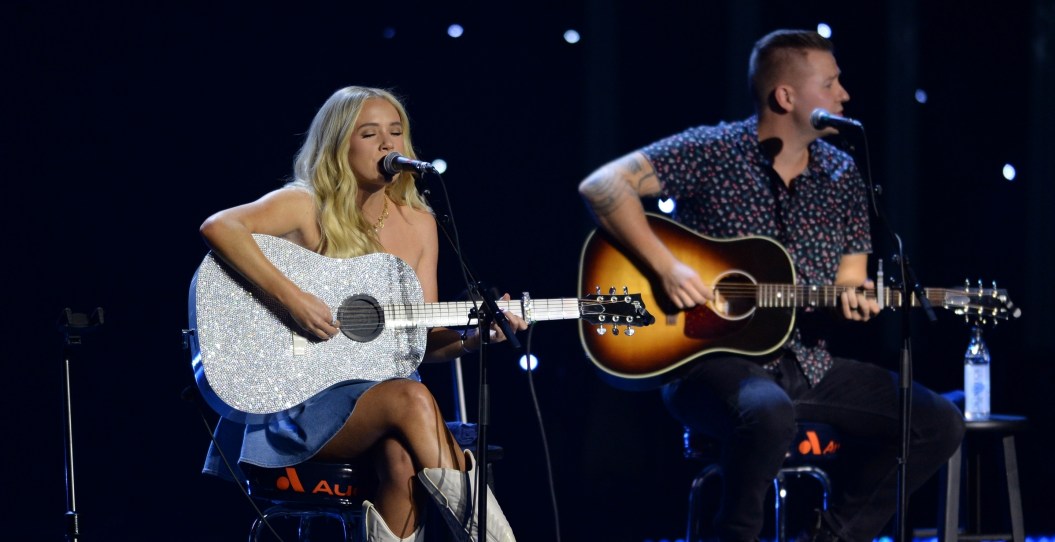
One of the most oddly enjoyable things that spectators feast upon at awards shows is the abundance of strange, unscripted moments. As is the case with any live broadcast, anything can (and often does) happen - an embarrassing wardrobe malfunction, a singer who messes up the lyrics of a song, or a presenter who has trouble reading the teleprompter. There was one uneasy interaction between two superstars at the American Music Awards (AMA) on May 26. The singing celebrities in question were Megan Moroney and Shaboozey. What was the issue with these two?
Videos by Wide Open Country
Megan Moroney Got A Dose Of Shaboozey Side-Eye
The two were on stage bestowing the award for favorite country duo or group. Per Page Six, Shaboozey read his prepared remarks. "Country music has been an important part of AMA history. The very first year of this show [1974], this award for favorite male country artist went to the great Charlie Pride."
Moroney read her lines next. "That same year, favorite female artist went to Lynn Anderson, and the award went to the Carter Family, who basically invented country music."
That was when Shaboozey did his disbelieving side-eye of Moroney. The next day, he took to X to post, "When you uncover the true history of country music, you find a story so powerful that it cannot be erased..."
It seems like his beef was with whoever wrote what Moroney was reading, and not with her.
Does The Carter Family Really Deserve Credit For Inventing The Country Music Genre?
According to Rolling Stone, Black artists of earlier eras often have been denied their rightful, well-earned due. They helped to create country music. As far as the Carter Family goes, the outlet notes that "While the Carter Family are indeed country pioneers, they are also a perfect case study in the way country history has been whitewashed."
Lesley Riddle, a Black guitarist, was highly influential in the Carter Family's success and evolution. However, he has historically been marginalized in that regard. By the 1960s, the outlet contends, Riddle finally got more of the recognition he earned and deserved. There were also other Black artists who also played key roles in the country music genre. They also were rarely accorded the spotlight their white counterparts received.
Perhaps that awkward AMA moment will turn that spotlight more brightly upon Black singers, songwriters, and musicians of yesteryear. Their robust, combined efforts have helped make country music what it is today.


