
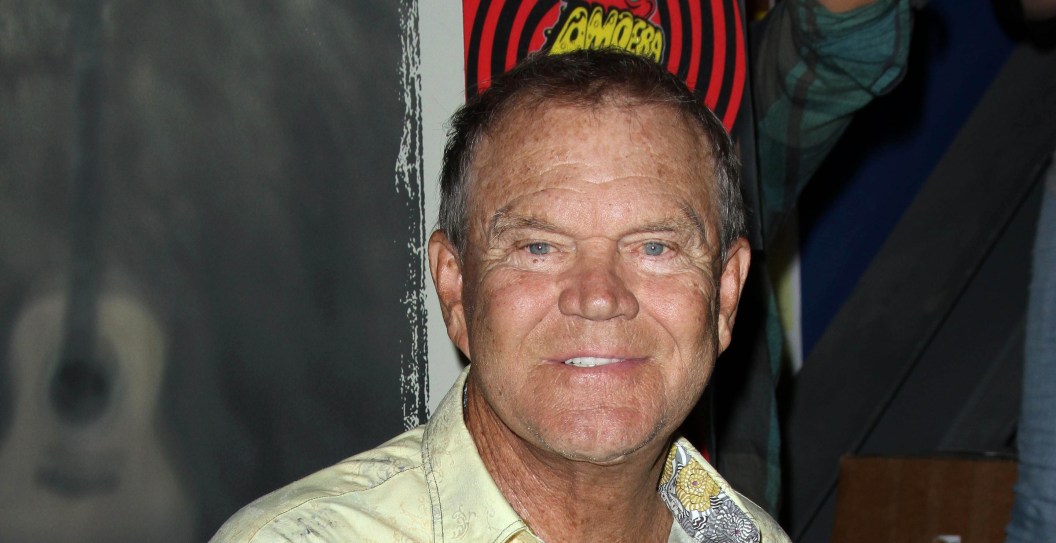
The name Jimmy Webb might not ring a bell with you. The names of his many hit songs will, through. Now 78, he wrote memorable tunes including "MacArthur Park," "Up, Up And Away," and "Worst That Could Happen." Some of the renowned artists who recorded his tunes are Art Garfunkel, John Denver, Joe Cocker, Linda Ronstadt, Johnny Cash, the 5th Dimension, Richard Harris, and Michael Feinstein.
Videos by Wide Open Country
According to the Songwriters Hall of Fame, which Webb was inducted into in 1986, "Jimmy Webb's accomplishments as a composer, arranger, and producer demonstrate beyond question that he remains as important and vital a cultural figure today as he was over thirty years ago. Embraced by his peers, Webb has influenced and affected some of the finest musical talents of our time."
Jimmy Webb Teamed With Glen Campbell To Create Many Once-In-A-Lifetime Hits
One of those talents was the late Glen Campbell (1936-2017). Webb, a triple Grammy winner, and Campbell successfully collaborated on many hit songs that ultimately helped to define both of their careers. Campbell recorded about 80 Webb tunes, per easyreadernews.com. Webb effusively described his fascination with and respect for Campbell in 2016.
"The first time I heard Glen on record I was 14 years old and was plowing wheat in northwestern Oklahoma. I prayed that I would have the chance to work with him. Five years later I was in L.A. and we had a single in the top 20. It was a cohesive mutually beneficial and productive relationship from the very first moment until the last. This was an inspired, destined collaboration."
Three of Jimmy Webb's songs from the 1960s became inextricably linked with Campbell. They are "By The Time I Get To Phoenix," "Wichita Lineman," and "Galveston." Those songs, each suffused with wistful yearning, played to all of Campbell's strengths and established him as a major star.
'By The Time I Get To Phoenix' (1967)
The tune was first recorded by Johnny Rivers in 1965. Then Glen Campbell came along two years later and masterfully covered it. Frank Sinatra reportedly said it was "the greatest torch song ever written," per crankydriver.com. Based loosely on an actual relationship of Webb's that went sour, per countrythangdaily.com, the song earned coveted industry kudos. It landed two Grammy awards; the album it's on got one as well.
Webb explained the almost magical alchemy between his songs and Campbell's interpretation of them. "I think that Glen's voice is perfectly suited to early JW [Jimmy Webb] - 'Wichita Lineman' and 'By the Time I Get To Phoenix' there was some kind of a surreal fit between his voice and those songs. It's very hard for me to look back and say, 'Oh, a-ha, now I see why we were successful.' Because at the time, it certainly wasn't anything that I was in control of."
'Wichita Lineman' (1968)
Per American Songwriter, Webb articulated the thought process behind writing "Wichita Lineman." "I wanted it to be about an ordinary fellow. Billy Joel came pretty close one time when he said 'Wichita Lineman' is 'a simple song about an ordinary man thinking extraordinary thoughts.' That got to me; it actually brought tears to my eyes. I had never really told anybody how close to the truth that was."
Webb had a huge hit on his hands. Campbell's recording of the song amplified its beauty. It went into the Library of Congress' National Recording Registry five years ago, one of the loftiest honors a tune can possibly receive. According to the Bob Dylan Fan Club on
Facebook via American Songwriter, Dylan said that "Wichita Lineman" is "the greatest song ever written."'Galveston' (1969)
The elegiac song "Galveston" has an undertone of such weary sadness and longing! Campbell makes the most of it. Per Chron, he was alerted to the song by popular singer Don Ho. Ho appeared on Campbell's variety TV show and indicated that he thought "Galveston" could be a good choice for Campbell. Ho's own version of the song wasn't too successful, it seems. The opposite was true for Campbell. The song fit him like a glove.
Per the outlet, "Because the fighting in Vietnam was such a huge part of the '60s, most people assumed that's what Campbell was singing about," especially with lyrics like "...Wonder if she could forget me / I'd go home if they would let me / Put down this gun / And go to Galveston...."
Campbell sidestepped any controversy, though. He altered the words to read like this. ...I still hear your sea waves crashing / While I watch the cannons flashing / I clean my gun / And dream of Galveston..."


