
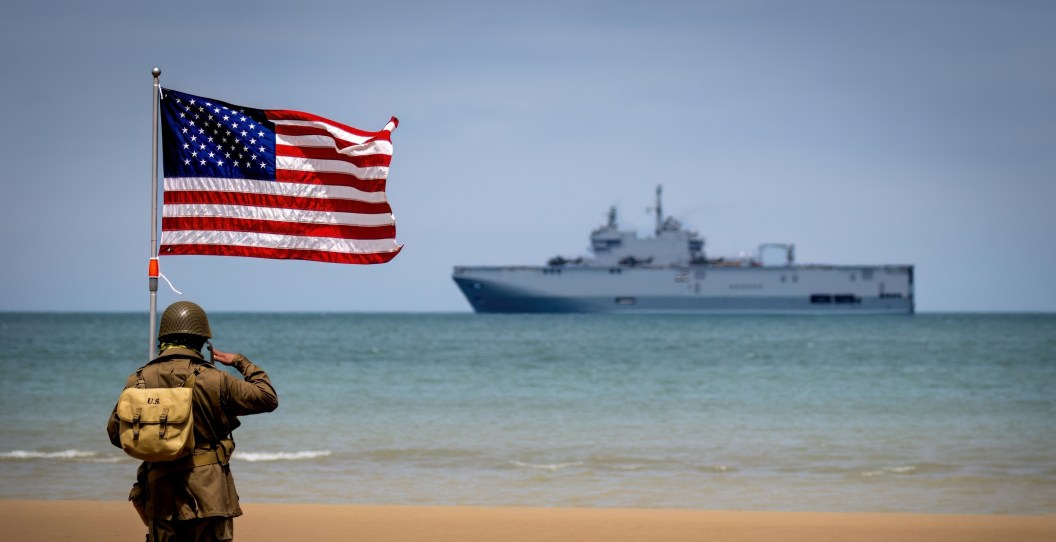
The date June 6, 1944 may not mean a lot to many people. But it was truly a turning point in modern history. On that date 81 years ago today, the D-Day invasion took place. It was one of the boldest, most daring wartime campaigns ever attempted. Intended to end the stranglehold that Adolf Hitler's brutal regime had on Europe, it was for all intents and purposes the start of the final phase of World War II.
Videos by Wide Open Country
You may have seen the first few minutes of Steven Spielberg's epic war film, Saving Private Ryan. If so, you know what a fierce bloodbath ensued when Allied troops stormed onto the beach at Normandy. They were met with a relentless hail of enemy gunfire that made the water run red. Yet these brave heroes fought on with valor and dedication. They had a mission and they would fulfill it, no matter the cost.
Setting The Stage For The Invasion
That daring, top secret mission was referred to as Operation Overlord. It involved positioning 156,000 Allied troops from America, the United Kingdom, Canada, and other nations on Normandy's beaches, per history.com. It is hard to comprehend how ambitious, hush-hush, and complex this landing really was. In fact, a clever, large-scale effort geared to mislead the Germans was deemed necessary to hoodwink them into thinking that we would land elsewhere, not at Normandy.
General Dwight Eisenhower was the supreme commander. On June 6, he gave the troops the green light with these fateful words now carved into the annals of history. "You are about to embark upon the Great Crusade, toward which we have striven these many months. The eyes of the world are upon you."
The Scale Of The D-Day Invasion Was Monumental
Per the outlet, "At the time, the D-Day invasion was the largest naval, air and land operation in history, and within a few days about 326,000 troops, more than 50,000 vehicles and some 100,000 tons of equipment had landed."
They surmounted numerous difficulties. Per nationalww2museum.org, the weather was iffy on the planned day of the invasion, so it was postponed from June 5 to June 6. Also, the beaches were heavily fortified. Making a landing would be extremely arduous.
The Allied losses were utterly heartbreaking. Approximately 4,000 troops made the ultimate sacrifice in order to establish our presence in German-controlled territory. Countless others sustained injuries or were missing.
The Allies' Resolve Made The Tide Of The War Turn
Hitler took his own life in a bunker on April 30, 1945. It would take until May of that year for the Germans to finally surrender.
There is no way to overestimate the significance of the Allied triumph on June 6. According to the National WW II Museum, "The way to appreciate D-Day's importance is to contemplate what would have happened if it had failed."


